THE LOST WORLD, Rio Verde, Brazilian Mato Grosso 2001
by Simon Chapman
“Above us towered the Ricardo Franco hills, flat topped and mysterious, their flanks scarred by deep quebradas. Time and the foot of man had not touched these summits. They stood like a lost world, forested to their tops, and the imagination could not picture the last vestiges of an age long vanished.” (Lt Colonel PH Fawcett. Expedition Fawcett 1908)
This description and Fawcett’s 1908 expedition became the inspiration for Conan Doyle’s famous book “The Lost World”. In July 2001 Simon Chapman set out to retrace the Fawcett expedition’s route. Below follows an excerpt from Simon Chapman’s article about his expedition:
Our plan was to travel to the Brazilian Mato Grosso and investigate Colonel Fawcett’s claims. The fact that apparently no one had ever done this before, to me made the idea irresistible. We would follow the explorer’s 1908 route up the Rio Verde on the Bolivian border, then climb the mountain which he asserted was the true Lost World.
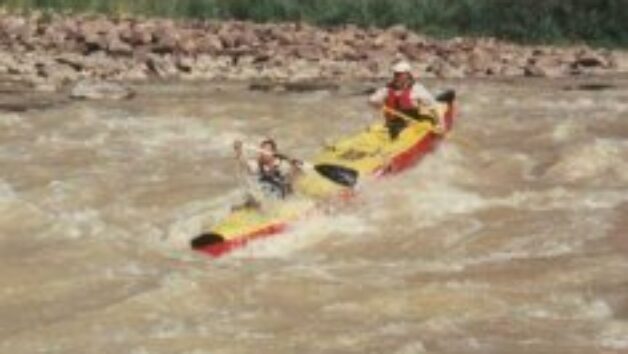
For our trip, we opted to cut out the section on the wide river Guapore, riding by jeep along ranch tracks that took us to within five miles of the Verde, then carrying the canoe- its component skin and poles distributed among us to the river. Four of us were to travel in the canoe; myself, Derek, a geography teacher; Dave, our photographer, and Badu, a guide we had hired in Vila Bela. As the only Brit with jungle and canoeing experience, my job was to get us up the river. Four of us plus equipment in one 17 ft canoe. I knew this would be overloading the boat a little (certainly until we had eaten our way through some of the food), but having used a 16.5 ft PakCanoe on two previous expeditions in Bolivia, I foresaw no real problems, on the flat water close to the river’s mouth at least.
The easy part of Fawcett’s journey ended when the party reached the Ricardo Franco hills and the rapids began. The weight of their dugout canoe would have prevented the group portaging or dragging it up the rapids. Perhaps this is why in his fictional expedition, Conan Doyle equipped his explorers with two canoes made of skins stretched over a bamboo framework, light and easy to carry over the rapids. Our canoe, with its neoprene skin and aluminum framework was very much the modern version, a real bonus for transporting it past stretches of the river.
The next few days were mostly taken up with the paddle-drag routine of negotiating rapids. This was hard enough in our lightweight canoe, and I could imagine the sheer slog it must have been for Fawcett and his men with their cumbersome dugout. Fawcett found the riverside jungle was tangled with thorny stands of tacuara bamboo which had to be machete-cut a path through. In his report to the Royal Geographic Society he wrote, ‘So difficult was the river to ascend that the peons were unable to carry more than their rifles, ammunition and a theodolite’.
Fawcett must have felt trapped by the Verde. The river runs between canyon walls, hundreds of feet high. Once committed to following it, the mapping party could only go on, or go back. Us too. As we relaxed in that last camp and watched the monkeys clambering up with comparative ease to the scrubby forest at the top of those unattainable cliffs, it was easy to understand how those earlier explorers might conjecture what unknown creatures might live up there.