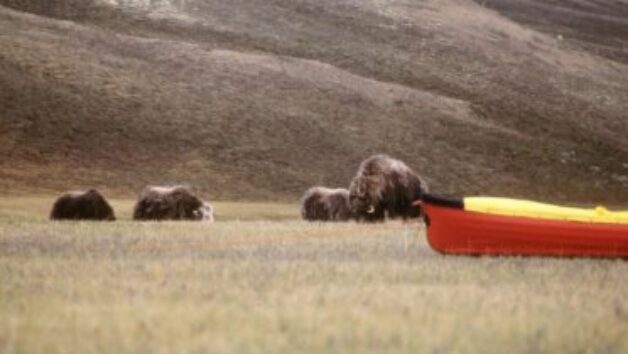
But the boats proved themselves to be fast, stable, capable of handling big loads, dry in waves, and remarkably tough.
BOATS ON THE RUN
(From article in “Canoe & Kayak Magazine”) August 2002
By Alan Kesselheim
The following is part of an article that deals with folding canoes. The article also describes use of folding kayaks and inflatables.
“Packing for your next big adventure? Don’t forget your boat.”
For me, this business started about three years ago. As long as I’ve been a paddler, I’ve known about boats you could pack up and take along like so much baggage, but I was leery. I’d heard too many horror stories that featured broken and irreplaceable parts two weeks into the boonies, atrocious paddling performance, finicky and somewhat suspect materials – in general, boats that required more pampering and coddling than a two-year-old.
But when my family and I took a trek to the Yukon River, the friends we were set to paddle with suggested using a folding canoe they’d had good luck with. Our other option was to beg, borrow, rent, or somehow transport a couple of traditional hardshell canoes. Nothing remotely workable or affordable along those lines presented itself.
The first lesson in our budding careers with boats-in-a-bag took place during a buggy June twilight on the bank overlooking the Yukon River near Dawson, where we unboxed two PakCanoes and laid out the pieces next to our camp. Half an hour later, with an assist from friends who’d assembled them before, we had put together, like giant Tinkertoys, a pair of boats that looked reassuringly similar to traditional canoes.
During the ensuing 300 miles and two weeks, I became a convert. The 17-foot folding PakCanoe (see below) was certainly different from its hardshell cousin. It was light enough that I was obsessively thorough about tying it down at stops. It exhibited an end-to-end wobble in waves that took some getting used to. I worried about abrasion and punctures a lot more than usual.
But the boats proved themselves to be fast, stable, capable of handling big loads, dry in waves, and remarkably tough. At the end of two weeks of wilderness travel, which included the onslaught of three children under age 10, the boats looked positively unscathed. I was impressed enough to forge deeper into the frontier of packable craft.
Expedition Canoe.
PakCanoe 170: An expedition-size canoe that fits into a duffel and weighs just 55 pounds, the 17-foot PakCanoe will handle two paddlers and their gear (900 pound capacity) for long trips. The hull is a tough skin of synthetic canvas, coated with PVC to withstand abrasion. The bottom incorporates an additional closed-cell foam layer bonded to the hull to increase durability. The fabric hull is stretched tight over a frame of anodized aluminum tubing. Finally, a set of inflatable tubes fit between the ribs and skin to provide cushion, wear protection, and extra flotation. My experience over several wilderness trips has been that the PakCanoe performs on a par with hardshell canoes, and actually stays drier in standing waves. It is straightforward to fabricate, and I’ve never had to make repairs in the field. My only gripe is that the seats, although perfectly workable, are a little difficult to lash firmly into place, and aren’t as comfortable as normal canoe seats.
Additional expedition accessories include spray cover, portage yoke, and kneeling pads.