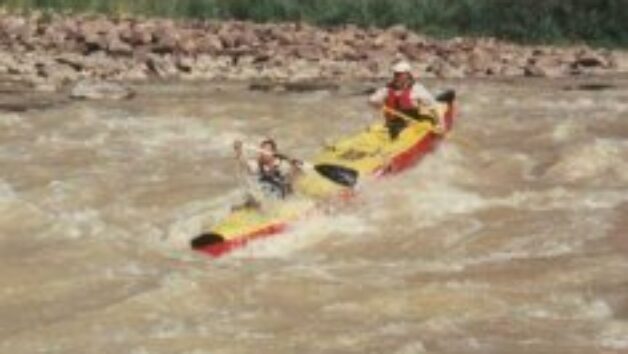
The 2001 trip would represent our most challenging conditions, because it rained for the first 14 days, and a river on the rise is always sobering.
Solo Paddling the Moisie River, Quebec, Canada 2001
THE SPIRIT OF THE NORTH
by Laurie Gullion
Our first view of the Moisie River from the Quebec-North Shore Labrador Railway is always an impressive one. From a dark tunnel the train bursts onto a trestle high over the river, and travelers can look into the heart of the final canyon along a stretch of Class II through IV rapids that hammers through the gorge. My heart also starts to hammer when I am reminded how big and wide the river really is. Last summer on July 5 we peered through a haze of misty rain from the train windows to see a river in flood.

Our itinerary allowed three weeks to reach the canyon, and we reassured ourselves that the floodwaters would recede by the time we descended to that point. My husband Bruce Lindwall and I were beginning our first remote trip without the support of our usual paddling friends–our first trip “alone.” Rather than paddle a tandem canoe, we decided to take two solo Pakboats to enhance safety and rescue in the Moisie’s very technical rapids. The river is also notorious for long portages, and the 40-pound boats would ease the strain of boggy and rocky paths. We’d paddled the river in 1991 under low water conditions and sunny skies, which is abnormal for the Labrador plateau where the river begins in a series of large, pristine lakes. In 1993 moderately high water and periodic rain gave us a new respect for the river’s force.
The 2001 trip would represent our most challenging conditions, because it rained for the first 14 days, and a river on the rise is always sobering. Each night we placed a stick at the river’s edge and watched it disappear underwater by morning. Because we traveled each day, it became difficult to measure the overall rise. Overshadowing our increasingly conservative decisions on the river was the reality of the final canyon.
Several strategies paid big dividends for us. On the upper lakes we paddled the Pakboats a 14 footer and a 15 footer with kayak paddles, which allowed us to match our mileage in tandem canoes from the previous trips. Canoe widths of only 30″ and 31″ inches make kayak strokes very efficient in the Pakboats. Staying on schedule in the upper lakes and river was psychologically reassuring, because we knew we might have to portage rapids we’d paddled previously in the middle and lower reaches. Water swirling into the bushes made the prospect of lining quite impossible, and we speculated that we might face difficulty at the Moisie’s Class IV rapids, which are often guarded by short, severe drops that end in a waterfall.
The extra power and quick corrections offered by the double-bladed paddle allowed us to handle the open and windswept lakes quite easily in the Pakboats, especially because shifting pack weight into the bow and stern helps the canoes to track well. On the river in Class I and II rapids, our ability to ferry powerfully was enhanced by the kayak paddles, when we found ourselves on the wrong shore above a rapid. Generally we stuck to inside bends to scout and get out of the main flow, but we often had to change sides at the corner to find the best route.
The rockiness of the upper river had disappeared in big waves, and our challenge was keeping the canoes dry. The Pakboat’s flexible frame made it possible, because the canoe rises over waves and sheds water beautifully. We stayed amazingly dry in Class III rapids filled with crosscurrents and exploding waves by picking our way carefully and actually cruising through holes I would normally avoid. The canoes remain remarkably buoyant in frothy water, given the air sponsons along each side. Bruce and I have never developed much comfort with spray covers and the confinement of a spray skirt around the waist. We appreciate the ability to rapidly scramble out of a canoe if necessary, which we were able to do here in tense moments when portage trails seemed to appear at the lip of a drop.
However, I did capsize my canoe when trying to sneak past the edge of a hole, where a boiling eddy line sucked one gunwale underwater. By the time I hit the next two wave trains, my canoe turned into a low rider. The benefits of the Pakboat’s air chambers became apparent, because they stabilized the canoe to prevent any overturning. I used lots of low braces and forward strokes to reach the relative security of a pulsating eddy upright–although the boat completely filled with water and I was filled with adrenalin! It’s the first time I’ve capsized a canoe while paddling in a remote location. A spray cover would have prevented the capsize, but I still prefer to paddle without one for speedy exits onto shore if necessary a strategy I used very successfully farther downstream.
We reached the government-operated fish ladder on Day 16, which had opened only the previous day. The start-up was two weeks late due to high water conditions, and the operator said the river had risen 5 feet on his gauge in the last week! We started to speculate about hopping back on the train just before the canyon which would still be raging. We’d paddled it before under less challenging conditions, had been impressed by its character, and agreed that we didn’t need to challenge ourselves after an excellent but arduous trip. The Department of Transportation regulations now severely restrict the number of stops on the rail line, and we knew we’d need to call out to arrange for the train to stop. Fred Burroughs, the proprietor of Pourvoirie Haute Moisie Inc. just 10 kilometers downstream, had a new satellite phone that the fish ladder operator assured us we would be able to use.
In one of those great moments of serendipity, we paddled up to Fred’s dock at the same time that the first of two float planes landed to bring in a party of six canoeists from Quebec City. The hospitality of the North is such that Fred invited us into the fishing club for the best carrot cake I’ve eaten, while we waited for the trip leader to arrive in the second plane. Each year this group of six from the Quebec Recreational Canoeing Association chooses a different river for a 5-day trip. And they offered us their empty charter back to Sept. Iles and refused our offer of payment. Offered the opportunity to eat fresh crab and drink a fine wine in the comfort of our favorite local restaurant (Chez Omer), we jumped at the chance. Within 15 minutes, we disassembled the Pakboats, rolled up the shock-corded aluminum frames in the PVC skins, and dumped every ounce of wet gear into the float plane. No need to fuss with tying a boat onto the pontoons, since our duffel-sized boats slid right into the interior. Fred, his employees, and the six Quebecois watched in amazement at our efficiency in exiting the river. It was a new record in packing up the boats. We wished them much luck, tried not to grin too hard as the Otter lifted off the water, and appreciated the power of the lower river from the air as we flew back to the Saint Lawrence. Later that night the crab, scallops and shrimp was the best I’ve ever tasted.